
expansion.com
Companies and associations discussed how an appropriate sustainability strategy can help organizations become more competitive and attract talent and investment.
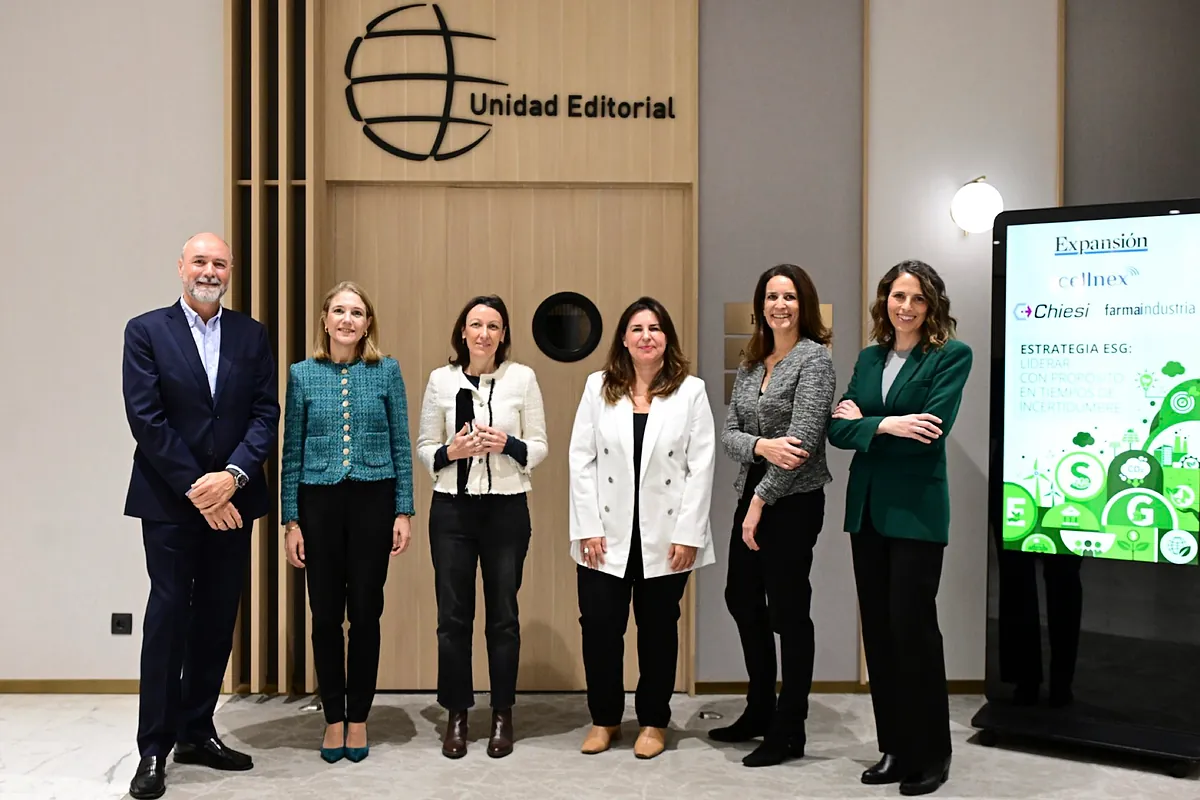
Companies that already integrate ESG criteria into their core business strategy and non-profit organizations working toward social and environmental sustainability gathered on December 19 in Madrid at the Observatory on ESG Strategy: Leading with Purpose in Times of Uncertainty. The meeting, organized by EXPANSIÓN in collaboration with Chiesi, Farmaindustria, and Cellnex, discussed sustainability from the perspective of regulatory compliance, but also as a lever for competitiveness, customer loyalty, and attracting investors.
Goretti Hidalgo, Head of Corporate Communications and Sustainability at Chiesi Spain & Portugal; Ana Bosch, Director of the Legal Department at Farmaindustria; Alicia Fernández del Viso, Global Director of ESG at Cellnex; Ana Herrero, Director of Sustainable Transformation at Forética; and Alicia Feliciano, Director of Development at the SERES Foundation, were the participants in the Observatory, which was presented and moderated by Pedro Biurrun, Deputy Director of EXPANSIÓN.
A company’s economic development must be linked to environmental and social development
Goretti Hidalgo, Head of Corporate Communications and Sustainability at Chiesi Spain & Portugal
From a regulatory perspective, the speakers addressed the impact of the Corporate Sustainability Reporting Directive (CSRD) and recent amendments to simplify it. In light of these changes, “in Chiesi’s case, the commitment remains the same,” said Goretti Hidalgo, for whom “a company’s economic development must be linked to environmental and social development.” At the level of the pharmaceutical industry as a whole, Ana Bosch defended the “need for regulatory clarification and simplification” so that these companies have legal certainty to work with. The uncertainty about the regulations that will be applied and their scope, together with the paralysis of the transposition of the European CSRD into Spanish legislation, are, for Bosch, the major challenges in this regard. Even with these challenges, Farmaindustria’s recent ESG survey reflects the commitment of this sector: 82% of its member companies have circular economy programs and 70% already use renewable energy for the production of medicines.
We need to review the business case for corporate sustainability, without focusing so much on regulation.
Ana Bosch, Director of the Legal Department at Farmaindustria
Cellnex, meanwhile, is committed to a sector-based approach, working with customers, suppliers, and peers in the industry. In line with this, it has promoted a Sustainability Working Group at the European level so that, for example, all its members calculate their carbon footprint in the same way. Faced with regulatory uncertainty “that causes a lot of damage,” Ana Herrero explained that Forética proposes “reviewing the business case for corporate sustainability”: focusing more on how it helps generate revenue, reduce costs, or attract talent, and less on regulation and compliance. And from the Seres Foundation, Alicia Feliciano asked whether, for companies, “sustainability is just compliance or is it also strategy,” always assuming that compliance can help to include social issues in the company’s strategy.
People and technology
If environmental and social sustainability is a strategy, it can also be considered a demand from society, especially from younger people. “The fact that companies are committed to equality and diversity is important,” said Bosch. At Farmaindustria, they work to raise awareness of the pharmaceutical industry among future professionals and attract young talent, while also running programs to include people with disabilities in the workplace. In this regard, Feliciano advocated for seeking alliances between companies and associations. At Chiesi, they see sustainability as “a different way of understanding how you do things,” in the words of Hidalgo, and that is where distinctive projects arise. Meanwhile, for Fernández del Viso, “sustainability has to be synonymous with efficiency.” When Cellnex makes an investment, they also apply sustainability criteria, he explained.
There is a need for regulatory clarification and simplification that gives companies legal certainty to operate.
Ana Herrero, Director of Sustainable Transformation at Forética
In terms of technology and innovation, the telecommunications infrastructure operator is working to train its staff in the use of new technologies such as artificial intelligence, while identifying where it makes most sense to use them. For Hidalgo, AI is a tool to help make more accurate diagnoses, provided that data is protected. AI is revolutionizing the pharmaceutical sector, Bosch pointed out, but he warned of the danger of bias and stressed that the final decision must always be in human hands. Forética recently launched the Manifesto for Responsible and Sustainable Artificial Intelligence, which has been signed by more than 80 companies and focuses on five aspects: zero emissions, respect for nature, human rights, diversity and inclusion, and governance.
Sustainability must be synonymous with efficiency, applying sustainability criteria when making an investment
Alicia Fernández del Viso, Global ESG Director at Cellnex
Another key aspect is the supply chain. How can we manage it in a way that is efficient, clean, and transparent? Feliciano highlighted the great difficulty that currently exists in the certification of suppliers and the problems faced by smaller companies in keeping up with larger ones in terms of sustainability. Fernández del Viso proposed an EcoVadis-type platform as a solution to assess the sustainability performance of partners, but one that is simple and affordable for small suppliers. From another angle, Bosch warned that we are imposing very strict sustainability requirements on our companies, but in the end they are competing with industries in countries that have lower environmental and social costs. This has an impact on the pharmaceutical sector, where companies from these countries often win tenders because decisions are made on the basis of price. He therefore argued that all companies wishing to compete in tenders in Europe should meet the same requirements in order to safeguard European strategic autonomy in the pharmaceutical field.
Companies must consider whether sustainability is just compliance, or whether it is also strategy
Alicia Feliciano, Director of Development at the SERES Foundation
Looking ahead, the Director of Development at the SERES Foundation was categorical: “Competitiveness must be social or it will not exist.” From another perspective, Fernández del Viso predicted that by 2030, there will be a strong focus on resilience, especially energy resilience, and the response to extreme weather events. Hidalgo and Bosch highlighted the importance of R&D&I in restoring the competitiveness of European industry, including pharmaceuticals and healthcare products. The latter called for “combining sustainability with competitiveness” and for sustainability not to limit the development of products that protect health. Herrero pointed to environmental and social adaptation, as human beings and as companies, changing the way we collaborate and innovate.

 ES
ES
 EN
EN