
The 19th Conference of Biomedical Research Technology Platforms brings together more than 200 representatives from public administrations, universities, patient groups and businesses in Barcelona
Experts stress that Spain’s research ecosystem needs to continue making progress in cooperation, knowledge transfer and business development, with the aim of generating innovation that has an impact on patients’ health and the country’s development in an international context fraught with threats and fierce competition
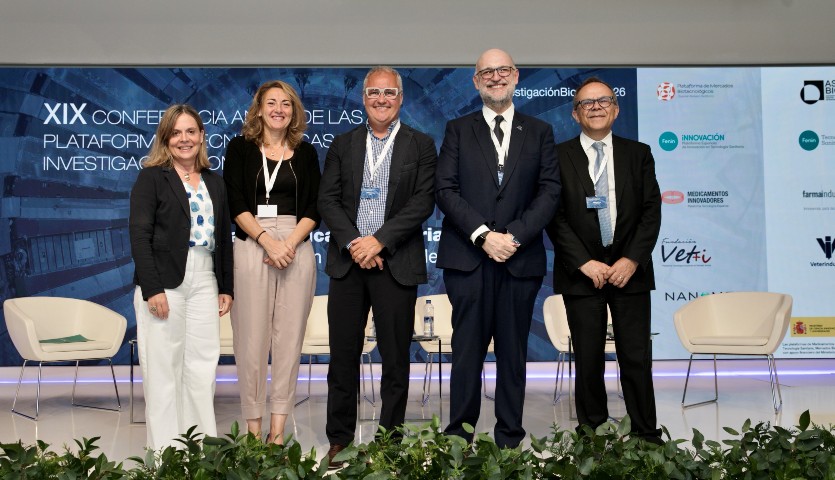
Fina Lladós, presidenta de Farmaindustria; Cristina Nadal, presidenta de AseBio; Andreas Föerster, presidente en Funciones de Fenin Cataluña; Santiago de Andrés, presidente de la Fundacion Vet+i, y Josep Samitier, coordinador científico de Nanomed Spain. | Foto: Sonia Troncoso
Farmaindustria.es
More than 200 representatives from the pharmaceutical, biotechnology, healthcare technology and animal health sectors, alongside experts from the Spanish Medicines Agency (Aemps), regional authorities, research institutes, patient organisations, start-ups, and pharmaceutical and healthcare technology companies, gathered today in Barcelona for the 19th Conference of Biomedical Research Technology Platforms, a leading forum for promoting collaboration and the development of R&D&I in healthcare in Spain.
Organised by Farmaindustria, AseBio, Fenin, Veterindustria and Nanomed Spain, the conference highlighted the importance of strengthening public-private partnerships and moving towards more effective models of cooperation between academia and industry. Our country has the opportunity to become one of the world’s leading centres for healthcare innovation. It is already a European leader in clinical research, but its consolidation as a global hub for biomedical research requires moving beyond and scaling up conventional public-private partnership models to achieve cooperation across the different phases of research into new medicines and therapies.
Against a European backdrop shaped by regulatory initiatives such as the European Health Data Space, the future European Biotechnology Act and the National Deep Tech Strategy, participants agreed that the challenge lies not only in accelerating research, but also in ensuring stable cohesion that enables knowledge to be translated into tangible solutions that improve people’s lives.
At the opening, the president of Farmaindustria, Fina Lladós, highlighted the need to make a qualitative leap to transform knowledge into a business ecosystem and competitive projects on a global scale. She drew attention to the current geopolitical context, “full of threats, risks and fierce competition between countries both within and outside Europe”. To address this, she said, three essential elements are needed: “A commitment from public authorities to make R&D a strategic priority; greater investment, particularly in the most complex phases of drug development; and a stable, predictable and agile regulatory environment that facilitates the development of new projects and instils confidence in those who choose to invest and grow in our country”.
The president of AseBio, Cristina Nadal, echoed this sentiment: “Spain has a world-class scientific and biomedical base, but we also need to translate that excellence into greater industrial capacity, attract more investment, and ensure that innovation reaches patients and society. Biotechnology is strategic for advancing competitiveness, technological autonomy and security, and for responding to major health and environmental challenges. At a decisive moment, initiatives such as the Biotech Act represent a unique opportunity to strengthen the innovation ecosystem, and Spain has the potential to establish itself as a key player in European biotechnology development.”
Scalability of innovation
From the perspective of health technology, experts have highlighted key issues for the future of the healthcare system, such as the integration of industrial and scientific capabilities, the scalability of innovation, and the need to create environments that foster the adoption of disruptive solutions. Furthermore, the growing role of Spain and Catalonia as hubs of biomedical and technological innovation has been highlighted, capable of connecting research, industry and healthcare to the benefit of competitiveness and the quality of care.
As Andreas Förster, acting president of Fenin Catalunya, stated, the meeting highlighted “the need to integrate scientific, technological and industrial capabilities to speed up the delivery of innovative solutions to patients and healthcare professionals”. “At Fenin, we maintain that health technology is a driving force in responding to the challenges of tomorrow, particularly in areas such as digitalisation, artificial intelligence, health data and advanced biomedical innovation. Forums for dialogue such as this are essential to consolidate Spain’s position as an international hub for health innovation,” said Förster.
From the perspective of animal health, Santiago de Andrés, president of the Vet+i Foundation, noted that animal health “plays a strategic role in the One Health approach at a time when, according to the World Organisation for Animal Health, around 60% of human infectious diseases are of animal origin and nearly 75% of emerging diseases are zoonotic. In this context, innovation, digitalisation and the strengthening of Europe’s strategic industrial autonomy are essential for improving prevention, surveillance and preparedness for future health crises.”
In line with the aim of establishing Spain as a leading hub for biomedical innovation, “at Nanomed Spain we wanted to highlight one of the sector’s major challenges: the effective translation of scientific knowledge into tangible health outcomes. As part of this conference, we have organised a round-table discussion focused on how to accelerate this process, addressing the key challenges and opportunities across the entire value chain, from research to clinical application. This session brought together leading figures from academia, industry and the healthcare system to discuss how to strengthen public-private collaboration, improve innovation models and align scientific and industrial excellence, with the aim of transforming scientific advances into real solutions that benefit patients and strengthen our country’s competitiveness,” explained Josep Samitier, scientific coordinator of Nanomed Spain.
The Annual Conference of Biomedical Research Technology Platforms has a track record spanning nearly two decades as a forum for collaboration between companies, research centres and public administrations, helping to strengthen the health innovation ecosystem in Spain.
At this year’s event, the organisers agreed that consolidating this ecosystem requires continued progress in cooperation, knowledge transfer and business development, with the ultimate aim of generating innovation that has an impact on patients’ health and on the country’s economic and social development.
 ES
ES
 EN
EN