
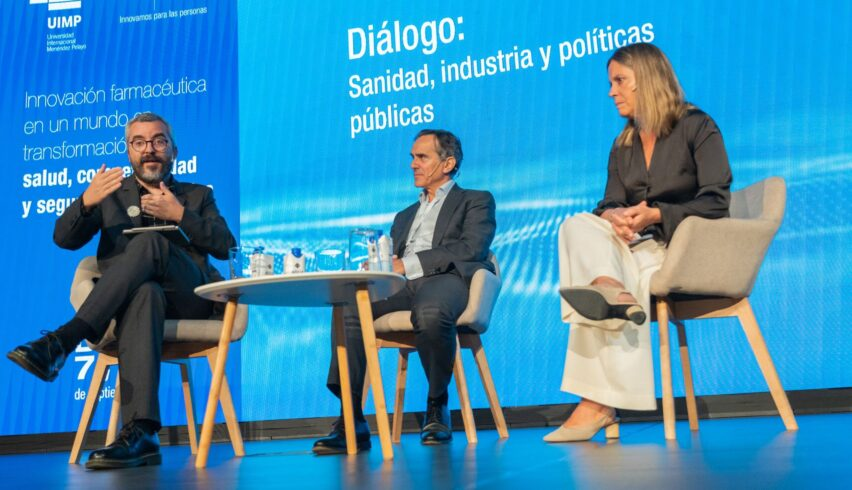
The Secretary of State for Health, Javier Padilla, and the President of Farmaindustria, Fina Lladós, took part this morning in an open discussion on the role of the pharmaceutical industry and public policy in the current turbulent international climate, during a panel discussion moderated by the Director-General of Farmaindustria, Juan Yermo,
The 25th Spanish Pharmaceutical Industry Conference at the UIMP brought together more than 200 experts from the pharmaceutical sector at a decisive moment for the future of the pharmaceutical industry
Farmaindustria.es
The second and final day of the 25th Spanish Pharmaceutical Industry Conference, organised by Farmaindustria at the Menéndez Pelayo International University (UIMP) in Santander, opened this morning with the discussion ‘Healthcare, industry and public policy’, one of the event’s key highlights. The session featured the Secretary of State for Health, Javier Padilla, and the President of Farmaindustria, Fina Lladós, in a discussion moderated by the trade association’s Director-General, Juan Yermo.
In his introduction, Yermo emphasised that dialogue between the sector and the government is now “more important than ever” against a backdrop of significant geopolitical uncertainty, and called for a national debate on the strength of the healthcare system, pointing out that Spain invests between 1.5 and 2 percentage points of GDP less in healthcare than the European average. Yermo also warned that Europe has lost 25 per cent of its investment in R&D over the last two decades and has ceded global leadership in the launch of new medicines, first to the United States and, since 2024, also to China.
When asked about the impact of US trade policy — in particular the Most Favoured Nation (MFN) pricing clause — on investment in pharmaceutical innovation in Europe, Padilla acknowledged the need for the European Union to offer “stability” at a time of great international uncertainty and, that said, expressed his commitment to working to remove certain existing administrative barriers in Europe. The Secretary of State explained that work is underway at European level to reduce the time it takes for pharmaceutical innovations to reach the market, and argued that shortening these lead times could be more effective for companies than extending the patent protection for their products.
Fina Lladós, for her part, has argued for the need for greater industrial protection in Europe for pharmaceutical innovations: “Reducing protection periods discourages innovation and would send a very negative message in terms of encouraging the pharmaceutical industry to invest in R&D on our continent,” she stated. The president of Farmaindustria pointed out that the European Union currently lags behind the United States, the United Kingdom and Switzerland in terms of intellectual property protection, and is only just ahead of China. She called on Spain to support, in Brussels, the extension of regulatory data protection to ten years, with an additional two years of market protection.
The president of Farmaindustria emphasised that getting the regulatory reforms currently underway right is key to continuing to attract this level of investment. “The geopolitical situation is forcing us to rethink how we respond. Europe must do so and, above all, it must make decisions quickly,” she urged.
The three speakers all agreed that the European Biotechnology Act represents a major opportunity to boost Europe’s competitiveness in attracting biopharmaceutical R&D. Lladós described it as “a unique opportunity” to provide the sector with a comprehensive framework of incentives.
The Medicines Act and ongoing reforms
Turning our attention to our own country and the legislative reforms currently underway, Lladós noted that the draft Medicines and Medical Devices Bill updates a regulatory framework that is more than two decades old and includes positive measures, such as compliance with the 180-day deadlines — 90 days in the case of medicines for which there is no alternative treatment — for decisions on pricing and funding. She pointed out that the text has incorporated improvements following the public consultation process, including the removal of mandatory discounts for new medicines, although she emphasised that some measures remain “such as new mandatory contributions from the industry that could undermine Spain’s ability to attract investors”.
In conclusion, the president of Farmaindustria emphasised that, above all technical and regulatory debates, people remain at the heart of the matter: “Behind every debate on regulation, there are patients waiting for an answer. Behind every decision on innovation, there are families longing for more time and a better quality of life,” she stated, expressing optimism about the sector’s and the government’s ability to continue improving the system.
The Director-General of Farmaindustria, Juan Yermo, brought the dialogue to a close by thanking both parties for the “candour” of the exchange and emphasising the importance of dialogue and collaboration between industry and the government as a means “for pharmaceutical innovation to continue transforming the lives of patients in Spain and across Europe”.
Three examples of the industry’s contribution to the country
Following the dialogue, the meeting moved on to a panel discussion on the pharmaceutical industry’s contribution to the country. Speakers at the panel included Federico Plaza, Director of Government Affairs at Roche Farma; Esther Mosquera, Country Manager at Faes Farma; and María Fernanda Prado, Managing Director of Johnson & Johnson Innovative Medicine. The representative from Roche emphasised that the pharmaceutical industry “is making a clear commitment to digital health, particularly in Spain”, an area he described as essential for the development of medicines and diagnostic tools and whose influence, he added, “is already taking hold in the country”.
For her part, Esther Mosquera pointed out that geopolitical and supply chain tensions, increased international competition and regulatory pressure “require a more resilient and autonomous pharmaceutical industry”, and she therefore called for “greater predictability in the sector’s legislation”. Similarly, María Fernanda Prado agreed that attracting investment to Spain depends on regulatory predictability, but also on “developing and retaining talent”, particularly in the field of data, which she described as crucial to the sector’s future.

María Fernanda Prado (Johnson & Johnson), Javier Urzay (Farmaindustria), Federico Plaza (Roche), Esther Mosquera (Faes Farma).
25 years of the sector’s key forum
Over the past 25 years, the Annual Pharmaceutical Industry Conference at the UIMP has established itself as one of the leading forums for reflection and dialogue on the present and future of healthcare, biomedical innovation and pharmaceutical policy in Spain. This year’s event is attended by more than 200 industry experts, including pharmaceutical policy makers from the autonomous communities, company executives, academics and patient representatives.
 ES
ES
 EN
EN