
Pipeline Innovation Review, carried out by the consultancy firm Iqvia for the European Federation of the Pharmaceutical Industry (Efpia) and Vaccines Europe, covers biomedical research underway in Europe and the main innovations expected in the coming years.
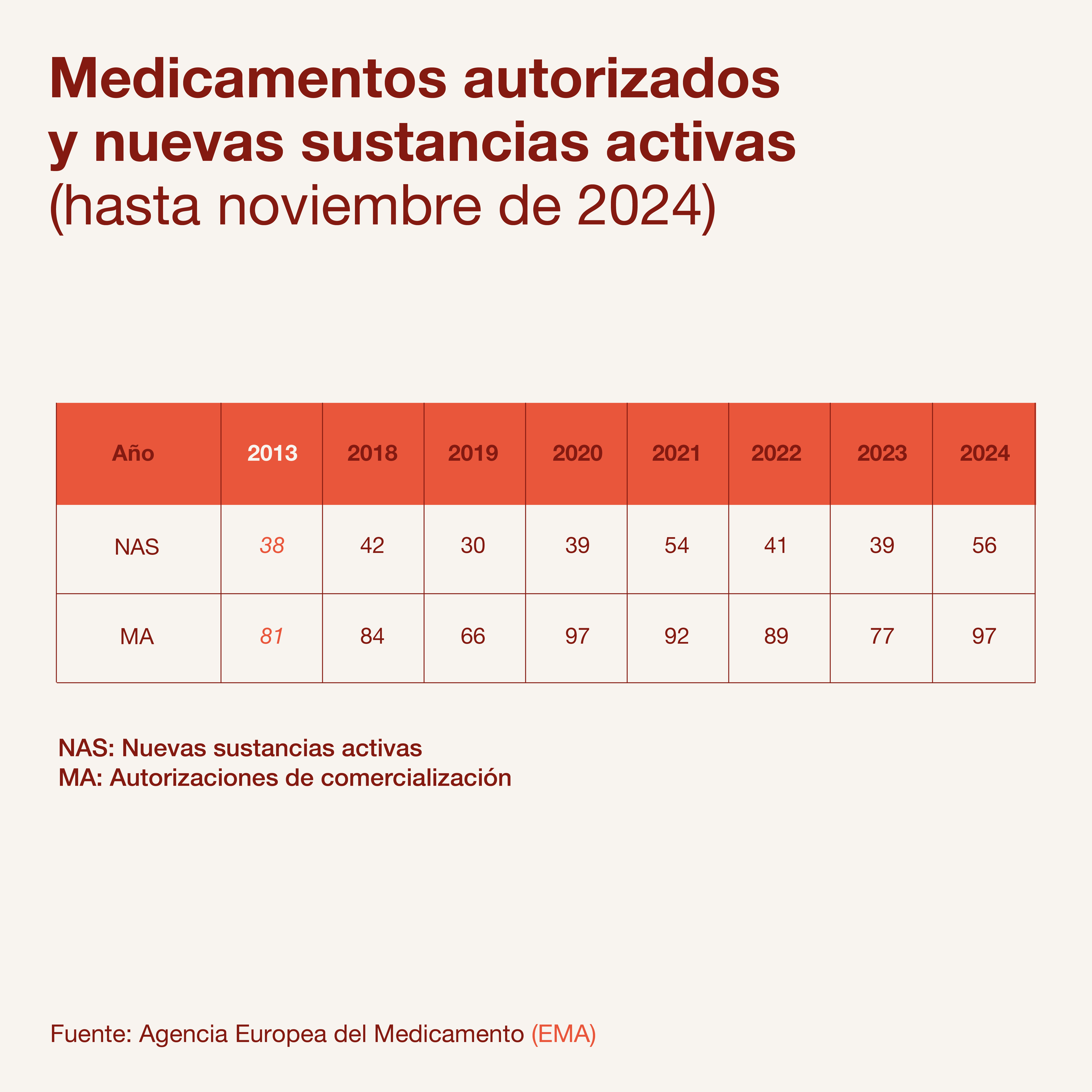
The report highlights that 97 new medicines have been approved in Europe so far this year, of which 56 are new active substances. In 2023, 77 new medicines were approved.

Farmaindustria.es
The number of people over 65 will double by 2050. The ageing of the population, coupled with climate change, changing lifestyles, increasing antibiotic resistance and other factors, will lead to an increase in diseases such as cancer, Alzheimer’s, chronic obstructive pulmonary disease (COPD) and diabetes in the coming years.
Profound societal changes will, however, also be met with advances in prevention and treatment that are expected to alleviate at least part of this disease burden.
This is the background to the Pipeline Innovation Review 2024 – Innovation for Unmet Needs, a report by the consultancy firm Iqvia for the European Federation of the Pharmaceutical Industry (Efpia) and Vaccines Europe, which covers ongoing research in Europe, as well as the latest authorisations from the European Medicines Agency.
The document highlights that in the first 11 months of 2024, 97 new medicines have been authorised for marketing (20 more than in 2023 as a whole), of which 56 are new active substances.
Farmaindustria.es
The report also lists the most important innovations that are expected to emerge in the coming years, which are concentrated in 10 specific areas:
- Vaccines against antimicrobial resistance: through multiple pathways, to reduce resistance and maintain the effectiveness of antibiotics.
- New antibiotics: antimicrobials with new mechanisms of action to address unmet needs in patients who do not respond to current antibiotics.
- Vaccines to prevent non-communicable diseases: Vaccines against viruses, e.g. Epstein-Barr virus, which are causally linked to the development of non-communicable diseases such as certain cancers, autoimmune and neurodegenerative diseases.
- mRNA vaccines for cancers: these vaccines, which have been shown to be safe and effective against Covid-19, usher in a new era of personalised vaccines, particularly in oncology.
- Gene therapies for Duchenne muscular dystrophy (DMD): new technologies that promise not only to alleviate symptoms, but also to slow or stabilise the progression of this rare disease with poor prognosis and low quality of life.
- RNA technology for elevated lipoprotein(a): New products against this protein, identified as an inherited risk factor associated with stroke and heart attack, are under investigation.
- Stem cells for neurodegenerative diseases: there is research into innovative treatments for Parkinson’s and other neurodegenerative diseases, which can reverse the progression of the disease by regenerating cells of the central nervous system.
- New drugs for obesity management: following the success of GLP-1 drugs, new generations and new mechanisms of action offer greater efficacy and improved side-effect profiles.
- Anti-IL treatments for COPD: the re-use of well-established anti-interleukin therapies in chronic obstructive pulmonary disease (COPD), a major cause of global disease burden, is being investigated.
- Novel therapies for major depressive disorder: New mechanisms of action that offer therapeutic options for patients with major depressive disorder, the incidence of which is increasing.
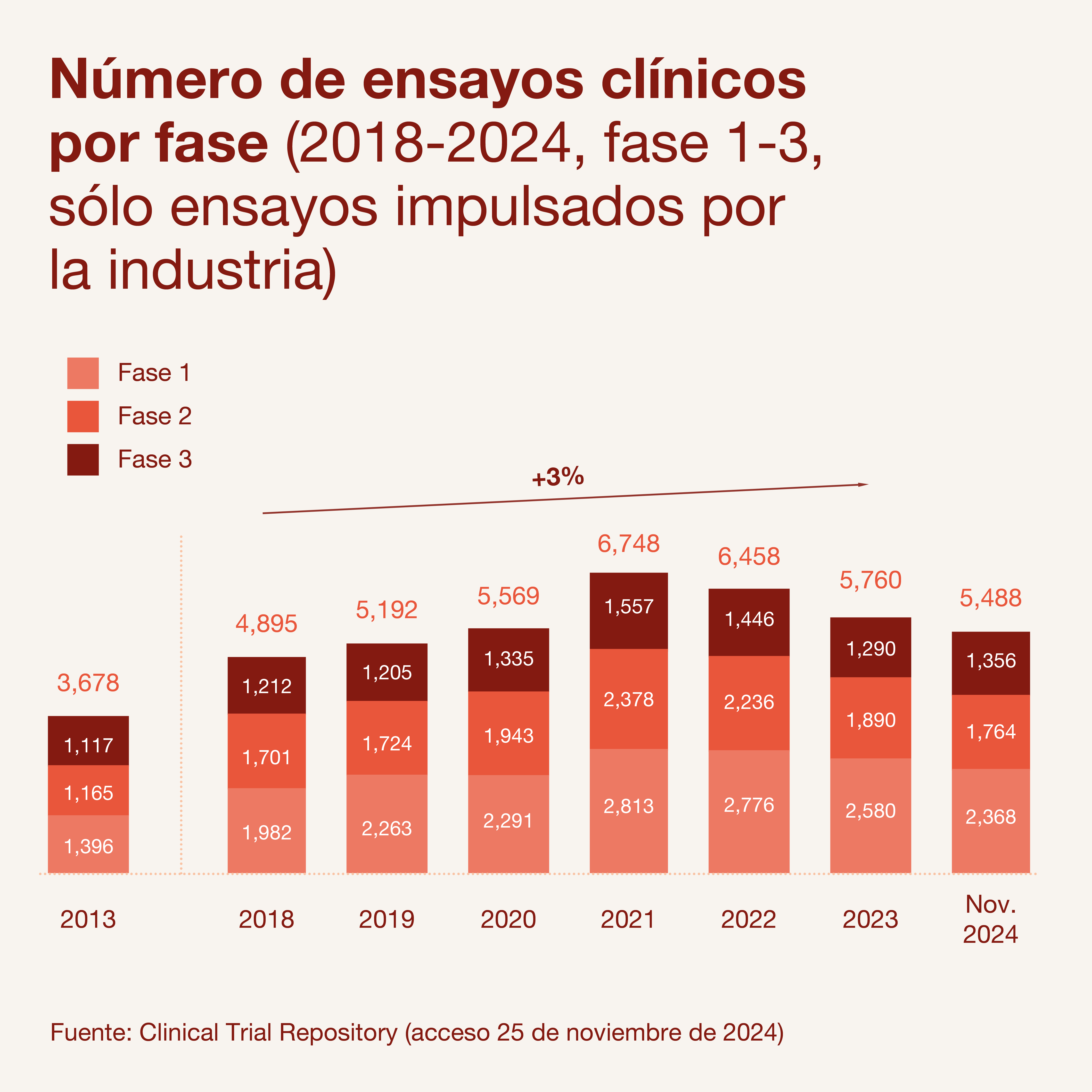
The report tracks the number and evolution of industry-sponsored clinical trials in Europe, which from January to November 2024 has reached 5,488 trials, more than half of them in Phase 1. The number of clinical trials peaked in 2021 due to the large number of Covid-19 trials, but if virus-related trials are removed, growth has been steady since 2013.
Farmaindustria.es
By area, oncology accounts for almost a third of clinical trials (29%). Advanced therapies such as CAR-T gene and cell therapies also occupy a significant share, reflecting strong investment in novel approaches to treating cancer.
Cancer mRNA vaccines are another promising research area for the coming years. Since 2022, 37 clinical trials have been initiated, mainly in phase 1. For colorectal cancer, three vaccines are in early phases, with first approvals expected in 2030.
Of the trials initiated in 2023, priority continues to be given to advanced or metastatic tumours such as lung and breast cancer. In addition, those with low survival rates such as pancreatic or colorectal cancer.
On the other hand, between 2018 and 2023, the therapeutic areas of cardiovascular diseases, infectious diseases and reproductive health have increased their presence in the clinical trial landscape.
Regarding antimicrobial resistance, which is considered a key area for biomedical R&D, the report highlights the increase in vaccines targeting these bacteria, but stresses the need to increase research as only four of the researches are considered innovative, thus underlining the urgency of strong incentives to reactivate this area.
Efpia CEO Nathalie Moll stresses that ‘this report is an important reminder that many people are still living with debilitating diseases for which new medicines could be an essential lifeline. It is exciting to see the scientific advances and the diversity of innovations coming from pharmaceutical companies to address these challenges’.
For the European pharmaceutical industry spokeswoman, the research in the report is ‘encouraging, but there is much more we can achieve if EU policymakers work with us to encourage research and development in this critical area of unmet need.
Europe’s pharmaceutical industry is key to the continent, as recently recognised by the Draghi Report. The report highlights the sector’s contribution to research and development and to the EU’s trade balance, and acknowledges the worrying trend of the continent losing ground to other regions of the world, mainly China and the US, especially in the areas of orphan drugs and advanced therapies, if regulation does not change.

 ES
ES
 EN
EN