
A new report by CRA for the European Federation of Pharmaceutical Industries and Associations (EFPIA) explains what Europeans stand to gain if the region regains competitiveness against the US and China
Spain is the only country in Europe that is gaining market share in clinical trials, but the continent has gone from hosting 22% of clinical research in 2013 to 12% in 2023
Farmaindustrai.es
Every year, pharmaceutical companies invest €55 billion in R&D in the European Union (EU), employ around 2.3 million people and generate more than €366 billion in exports.
Europe’s strength lies in its scientific capabilities, in manufacturing – annual growth between 2018 and 2022 exceeded that of China – and in its trade surplus. Without the pharmaceutical industry, the EU’s trade balance would shift from a surplus of €133 billion to a deficit of €88 billion.
However, these figures are not sufficient to maintain the region’s global competitiveness, as its competitors – primarily the United States and China – are advancing more rapidly and pursuing highly aggressive trade policies to gain market share in this strategic sector.
In clinical trials, Europe has gone from hosting 22% of research projects initiated in 2013 to 12% in 2023. This is an area in which Spain stands out as the only country in Europe that is gaining market share. This leadership is at risk and requires urgent measures to reverse the trend.
To analyse the industry’s potential in a global context, and at the request of the European Federation of Pharmaceutical Industries and Associations (EFPIA), the consultancy firm CRA (Charles Rivers Associates) has produced a report entitled ‘Assessment of Europe’s Competitiveness as a Location for the Life Sciences Industry’, which examines indicators across four key areas for attracting investment: research and innovation, manufacturing, regulation and trade policy.
€105 billion in investment over the next decade
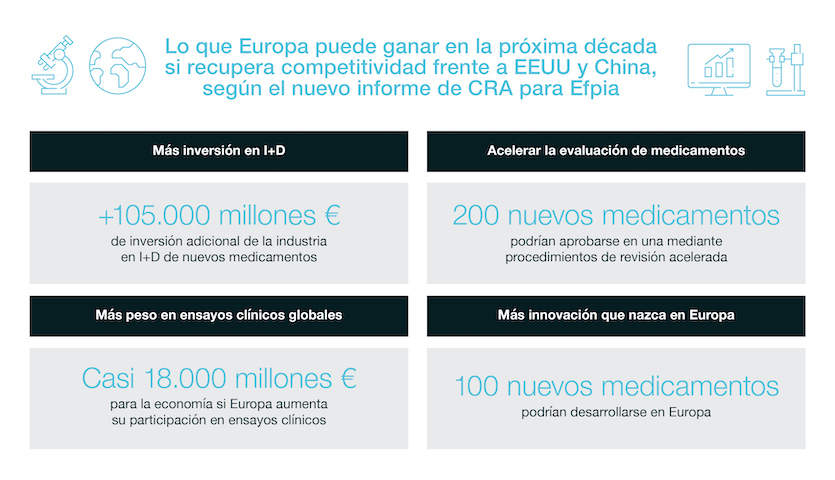
The study highlights the sector’s growth potential if it can close the competitiveness gap with other regions, particularly the United States and China. For example, if Europe were to increase its annual growth rate from 5.4% to 8.5% (with the US growing at 6.4% and China at 12.1%), this would generate an additional €105 billion in corporate investment over the next decade.
Furthermore, clinical trials are a source of wealth for the region. Increasing Europe’s share would contribute almost €18 billion to the economy over the next decade, as well as creating 82,000 jobs and enabling 158,000 more patients to participate in clinical trials.
Another area where global competitors are driving the sector forward is in the creation of regulatory and commercial environments that foster innovation. In this regard, if Europe streamlines regulatory procedures, more than 200 new active substances could be made available to patients and around 100 innovative medicines could be developed in Europe over the next 10 years.
The analysis highlights how European scientific excellence is failing to translate into R&D investment in new medicines at a crucial time when policymakers are seeking to strengthen Europe’s competitiveness. This is why the figures obtained help to inform the policy decisions that must shape the future of a sector that is fundamental to Europe’s health, economy and security.
“Enhancing Europe’s appeal for pharmaceutical investment will not only support economic growth and security, but will also ensure that European patients benefit more quickly from next-generation medical advances,” says Efpia’s Director General, Nathalie Moll.
The EU Biotechnology Act, currently undergoing public consultation, represents a major opportunity to strengthen European competitiveness and enhance the continent’s appeal for R&D investment. The future legislation aims to accelerate the market entry of innovative medicines, narrow the competitiveness gap with other blocs such as the US and China, and bolster biomanufacturing within Europe.

 ES
ES
 EN
EN